Go to main content
Phone number +1 514-730-9168 - Understand accessibility. Train your digital teams. Reach untapped markets.
Inklusiv
  • Home
  • About
  • Accessibility Training
    • Digital Accessibility Accelerator Program
    • Inclusive Leadership Self-Assessment (ILSA)
  • Info-Hub
    • Digital Accessibility
    • Inclusive Speaking (Archived)
    • Books
    • InklusivComm Personas
  • Newsletters
  • Testimonials
  • Connect
  • Home
  • About
  • Accessibility Training
  • Info-Hub
  • Newsletters
  • Testimonials
  • Connect
  • Phone: +1 514-730-9168
  • Email: [email protected]

InklusivComm
Food For Thought

Shared on Instagram and archived here, this section highlights some of our favorite - and hopefully insightful - quotes that might inspire you to become a more inclusive communication professional.

Recent Posts

  • Signal #006 – When experience is shared, not polished
  • Signal #005 – When accessibility data guides decisions, not explanations
  • Signal #004 – When “accessible enough” is left to interpretation
  • Did you know that accessibility saves money when planned early?
  • Did you know that procurement choices shape accessibility?
  • Did you know that accessibility risk is no longer theoretical?
  • Did you know that barriers are built into systems?
  • Did you know that accessibility goes far beyond screen readers?
  • Did you know that accessibility is a leadership reality?
  • Did you know that most top websites still fail accessibility checks?

Categories

  • Did You Know (Insights) (7)
  • Did You Know? (127)
  • Digital Accessibility Signals (6)
  • Food For Thought (127)
  • Inclusive Speaking Posts (100)
  • Inclusive Speaking Questions (127)
  • Inclusive Speaking Tips (127)
  • Inclusive Web Tips (125)
  • InklusivComm Interviews (61)
  • Media Appearances (57)
  • Other Stuff (5)

Tags

5ins 5tips a11y ableism accessibility accommodations ADD adhd ageing AI allyship anxiety arthritis articles audience auditory issues autism autoimmune disorders averages barriers bias blindness book bottom line business cerebral palsy challenges chatGPT chronic illness chronic pain cognitive issues colour colourblindness compliance crohn's disease culture data deadly sins deafness depression diabetes Did You Know? disabilities disability discrimination diversity dyscalculia dyslexia edge cases email emergency empowerment etiquette extremes fadeout town Food for Thought future gaad hard of hearing hearing loss iliana inclusion industry Insights interviews invisible IPS Test izumi John journey khaleem knowbility language lawsuits leadership learning legislation lizzy low vision market Maturity Signals media mental disorders mental health mindset mobility issues model neurodiversity neurological issues neuromuscular newsletter nick OCD opportunities personas photophobia plain language planners Podcasts posts powerpoint psychology PTSD publishing quadriplegic racism representation revenue roadmap RSI sanjay Sarah seniors service dog SMA social media spaces speaking spectrum spending power stigma strategies styles TBI tinnitus Tips tourette trends uma vertigo vestibular issues vision visual issues vivian wcag web workplace

Food For Thought #036

Last updated on January 16, 2023
by Denis Boudreau
  • Food For Thought
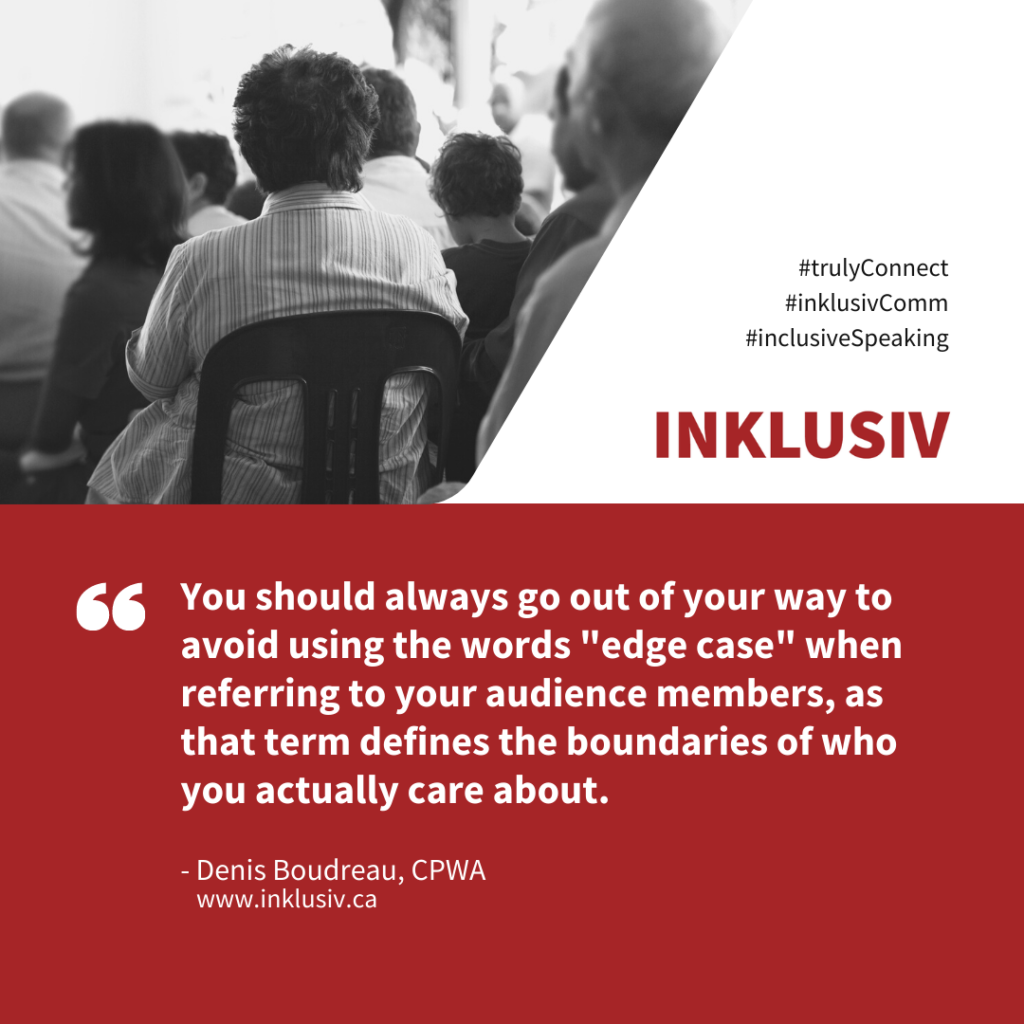
You should always go out of your way to avoid using the words "edge case" when referring to some of your audience members, as that term defines the boundaries of who you actually care about.

“You should always go out of your way to avoid using the words “edge case” when referring to some of your audience members, as that term defines the boundaries of who you actually care about.”

Denis Boudreau – www.inklusiv.ca

Food For Thought
Insights

  • #trulyConnect
  • #inklusivComm
  • #inclusiveSpeaking

Previous tip Random tip Next tip

A bit of a back story on that quote…

This particular quote was inspired by something I read a few years ago in one of my all-time favorite design books, “Design for Real Life“, by Eric Meyer & Sara Wachter-Boettcher. The original quote came from a tweet referenced in it, by a designer named Evan Hensleigh, and went like this: “Edge cases define the boundaries of who and what you care about”. In the book, the authors make the case for talking about “stress cases” instead of “edge cases”, arguing that those who live on the extremes of the human experience (due to disabilities or other circumstances) can indeed sometimes put some stress on the situation, the experience, or the design of things, but should not be dismissed because of those things. That rather, we, as speaking professionals, designers, content creators, etc. should embrace those extremes, embrace the stress they create, and use that energy as a catalyst to design more inclusively, so that those who live in the middle of the human experiences (oftentimes referred to as our average users), can also benefit from our broadened perspective as to how we’ve designed “the thing” (let’s say a presentation, a website, a PDF document, etc.). As a general rule, I’m fine dismissing a feature request as an edge case, but I have a much harder time dismissing a person as one. Maybe you agree, too.

Inklusiv Insights Newsletter

SIGN UP to receive our newsletter right into your inbox. Your daily or weekly dose of inspiring ideas, tips and tricks to become a more inclusive speaking professional.
How often do you want to receive our newsletter?(Required)
(You can change your preference at any time)
Consent(Required)
Denis Boudreau

About Denis Boudreau

Denis Boudreau is a consultant, trainer, and speaker specializing in digital accessibility and disability inclusion. He works with organizational leaders who want to equip their teams with the skills to create accessible websites and digital products – so no one is left behind. A Certified Professional in Web Accessibility (CPWA), Denis has trained thousands of web professionals over the past 20+ years and delivered hundreds of workshops in both English and French. He has helped leading brands like Netflix, Salesforce, and Victoria’s Secret embed accessibility into their digital strategies, empowering them to meet legal obligations, improve user experience, and connect with more people, more effectively.

Need some help? Book a free 30-min discovery call!

Is your digital experience  leaving people behind?

Every day, millions of people with disabilities are blocked from accessing information, services, and products – simply because organizations overlook digital accessibility. These aren’t edge cases. They’re your customers, your employees, your community.

At Inklusiv Communication, we help you change that. With over 25 years of experience, we train the teams who design, build, and maintain your digital platforms, ensuring accessibility is built in from the start.

If you’re ready to reduce risk, improve access, and serve everyone with dignity, let’s talk. Together, we’ll help you create digital experiences that don’t leave anyone behind.

“Accessibility framed as “important but secondary” always loses to urgent delivery pressures. What is not prioritized explicitly becomes optional in practice.”

~ Denis Boudreau, InklusivComm

Are you ready to truly connect?

"*" indicates required fields

Subscribe to our weekly or daily newsletter*
(You can change your preference at any time)

Drop by and come say hi!

Ideally situated right in the heart of the city, on the 19th floor of our beautiful, light-filled headquarters offer a breathtaking workspace that inspires us to create the most inclusive solutions for your business.

  • Inklusiv Communication
    235 Young street, Suite 1902
    Montreal, QC H3C 0Z6
  • +1 514-730-9168
  • [email protected]
Inklusiv Understand accessibility. Train your digital teams. Reach untapped markets.
All rights reserved © 2026 Inklusiv Communication
Branding by GoGo Telugo, Development by Ekloweb
Privacy policy | Personalize cookies
LinkedIn Youtube Instagram