Go to main content
Phone number +1 514-730-9168 - Understand accessibility. Train your digital teams. Reach untapped markets.
Inklusiv
  • Home
  • About
  • Accessibility Training
    • Digital Accessibility Accelerator Program
    • Inclusive Leadership Self-Assessment (ILSA)
  • Info-Hub
    • Digital Accessibility
    • Inclusive Speaking (Archived)
    • Books
    • InklusivComm Personas
  • Newsletters
  • Testimonials
  • Connect
  • Home
  • About
  • Accessibility Training
  • Info-Hub
  • Newsletters
  • Testimonials
  • Connect
  • Phone: +1 514-730-9168
  • Email: [email protected]

Inclusive Speaking Tip #127

Recent Posts

  • Leadership tip 001 – What never gets said never gets built
  • Did you know that accessibility saves money when planned early?
  • Did you know that procurement choices shape accessibility?
  • Did you know that accessibility risk is no longer theoretical?
  • Did you know that barriers are built into systems?
  • Did you know that accessibility goes far beyond screen readers?
  • Did you know that accessibility is a leadership reality?
  • Did you know that most top websites still fail accessibility checks?
  • Behind the Mic Podcast with Roxanne Derhodge & Carl Richards
  • Émission L’Épicerie (épisode 20250129)

Categories

  • Did You Know (Insights) (7)
  • Did You Know? (127)
  • Food For Thought (127)
  • Inclusive Speaking Posts (100)
  • Inclusive Speaking Questions (127)
  • Inclusive Speaking Tips (127)
  • Inclusive Web Tips (125)
  • InklusivComm Interviews (61)
  • Leadership Tips (Signals) (1)
  • Media Appearances (57)
  • Other Stuff (5)

Tags

5ins 5tips a11y ableism accessibility accommodations ADD adhd ageing AI allyship anxiety arthritis articles audience auditory issues autism autoimmune disorders averages barriers bias blindness book bottom line business cerebral palsy challenges chatGPT chronic illness chronic pain cognitive issues colour colourblindness compliance crohn's disease culture data deadly sins deafness depression diabetes Did You Know? disabilities disability discrimination diversity dyscalculia dyslexia edge cases email emergency empowerment etiquette extremes fadeout town Food for Thought future gaad hard of hearing hearing loss iliana inclusion industry Insights interviews invisible IPS Test izumi John journey khaleem knowbility language lawsuits leadership learning legislation lizzy low vision market media mental disorders mental health mindset mobility issues model neurodiversity neurological issues neuromuscular newsletter nick OCD opportunities personas photophobia plain language planners Podcasts posts powerpoint psychology PTSD publishing quadriplegic racism representation revenue roadmap RSI sanjay Sarah seniors service dog SMA social media spaces speaking spectrum spending power stigma strategies styles TBI tinnitus Tips tourette trends uma vertigo vestibular issues vision visual issues vivian wcag web workplace

Category Inclusive Speaking Tips

Shared on Instagram and archived here, this section shares a series of tips and tricks to become a more inclusive communication professional from your platform of choice (virtual or in-person events).
If you're going to rely on printed materials during workshops, activities and other types of audience interactions, make sure to also offer alternative accessible formats. Blindness & visual disabilities

“If you’re going to rely on printed materials during workshops, activities and other types of audience interactions, make sure to also offer alternative accessible formats.”

More details about Inclusive Speaking Tip #127
Keep in mind that poor lighting conditions can impair the audience's ability to perceive various combinations of colours and affect how they will experience your content. Colourblindness & visual disabilities

“Keep in mind that poor lighting conditions can impair the audience’s ability to perceive various combinations of colours and affect how they will experience your content.”

More details about Inclusive Speaking Tip #126
When designing your content, stay away from complex, condensed or cursive fonts that will be harder for your audience to interpret and read from a distance. Dyslexia & learning disabilities

“When designing your content, stay away from complex, condensed or cursive fonts that will be harder for your audience to interpret and read from a distance.”

More details about Inclusive Speaking Tip #125
Avoid the use of the word 'normal' when comparing different groups, as it can stigmatize the experience of marginalized audience members and make them feel excluded. General considerations

“Avoid the use of the word ‘normal’ when comparing different groups, as it can stigmatize the experience of marginalized audience members and make them feel excluded.”

More details about Inclusive Speaking Tip #124
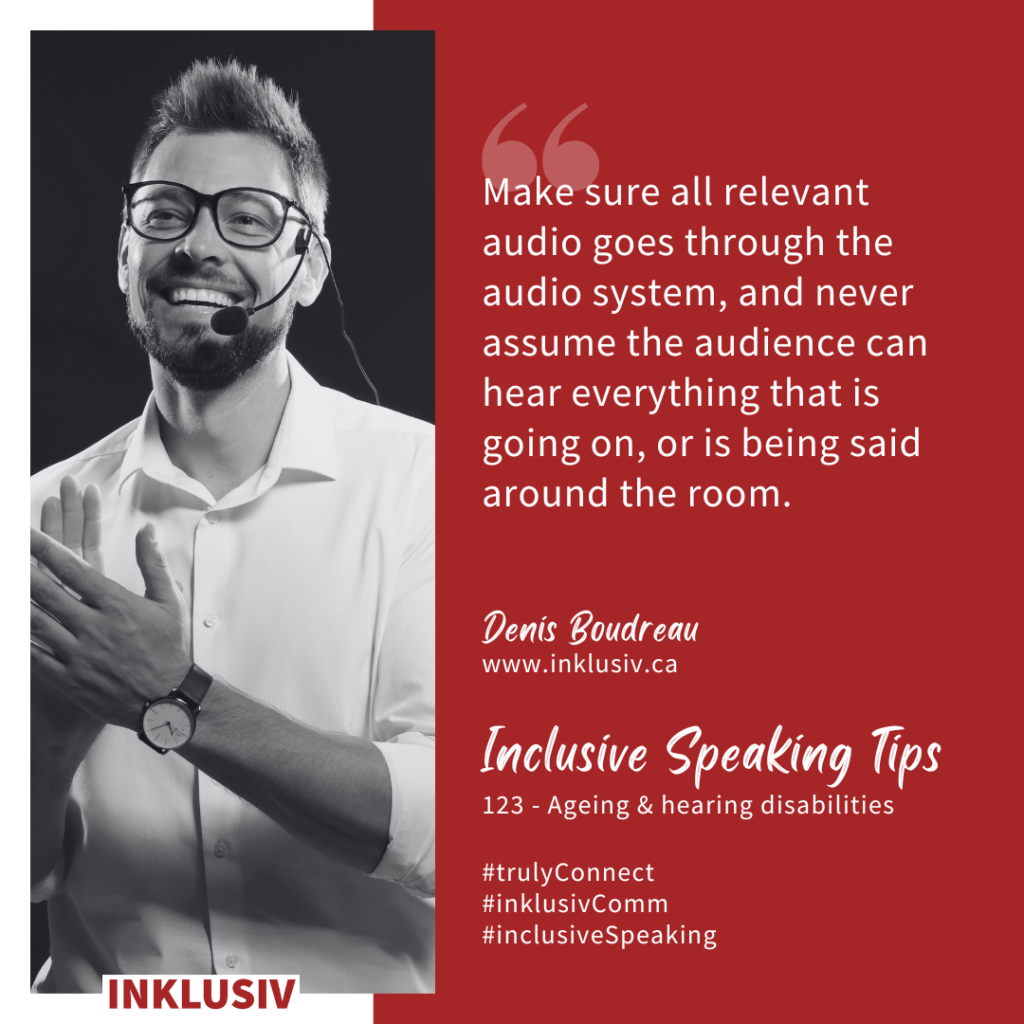
Make sure all relevant audio goes through the audio system, and never assume the audience can hear everything that is going on, or is being said around the room. Ageing & hearing disabilities

“Make sure all relevant audio goes through the audio system, and never assume the audience can hear everything that is going on, or is being said around the room.”

More details about Inclusive Speaking Tip #123
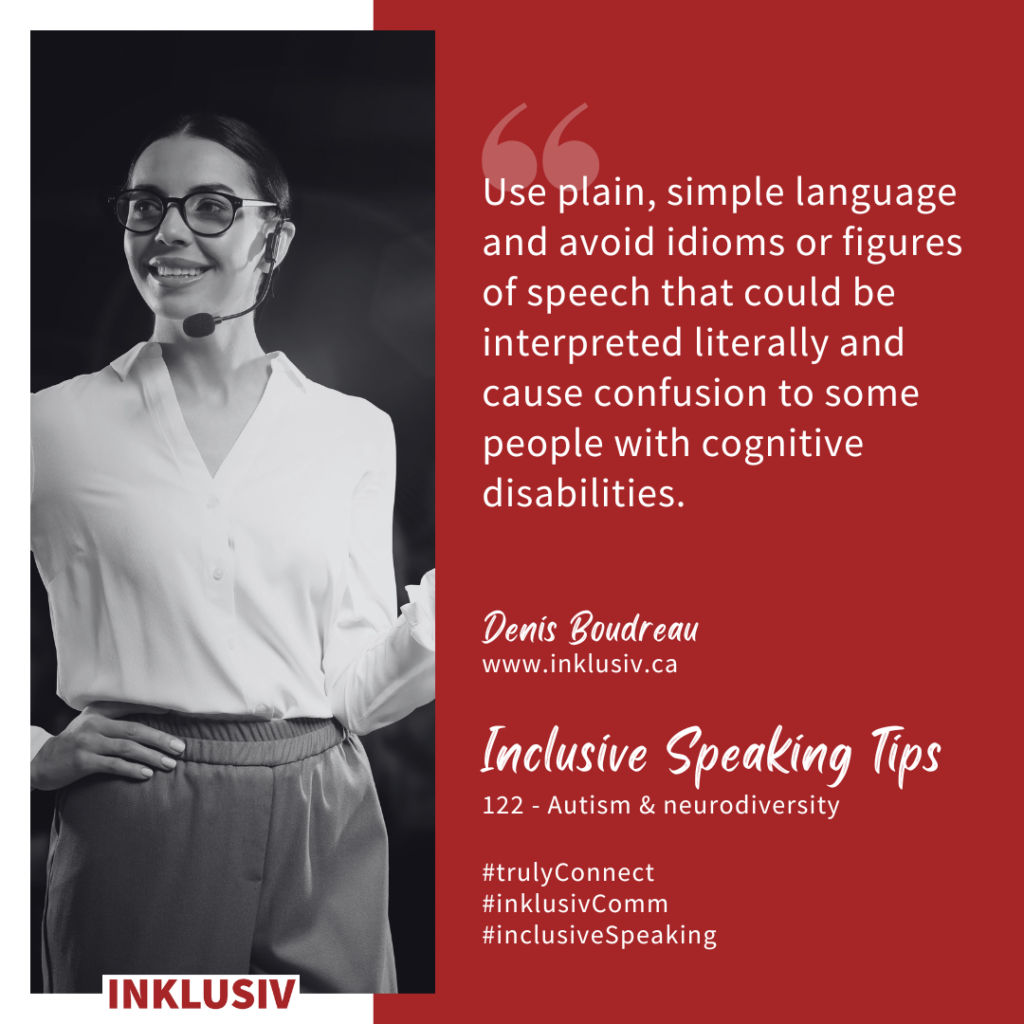
Use plain, simple language and avoid idioms or figures of speech that could be interpreted literally and cause confusion to some people with cognitive disabilities. Autism & neurodiversity

“Use plain, simple language and avoid idioms or figures of speech that could be interpreted literally and cause confusion to some people with cognitive disabilities.”

More details about Inclusive Speaking Tip #122
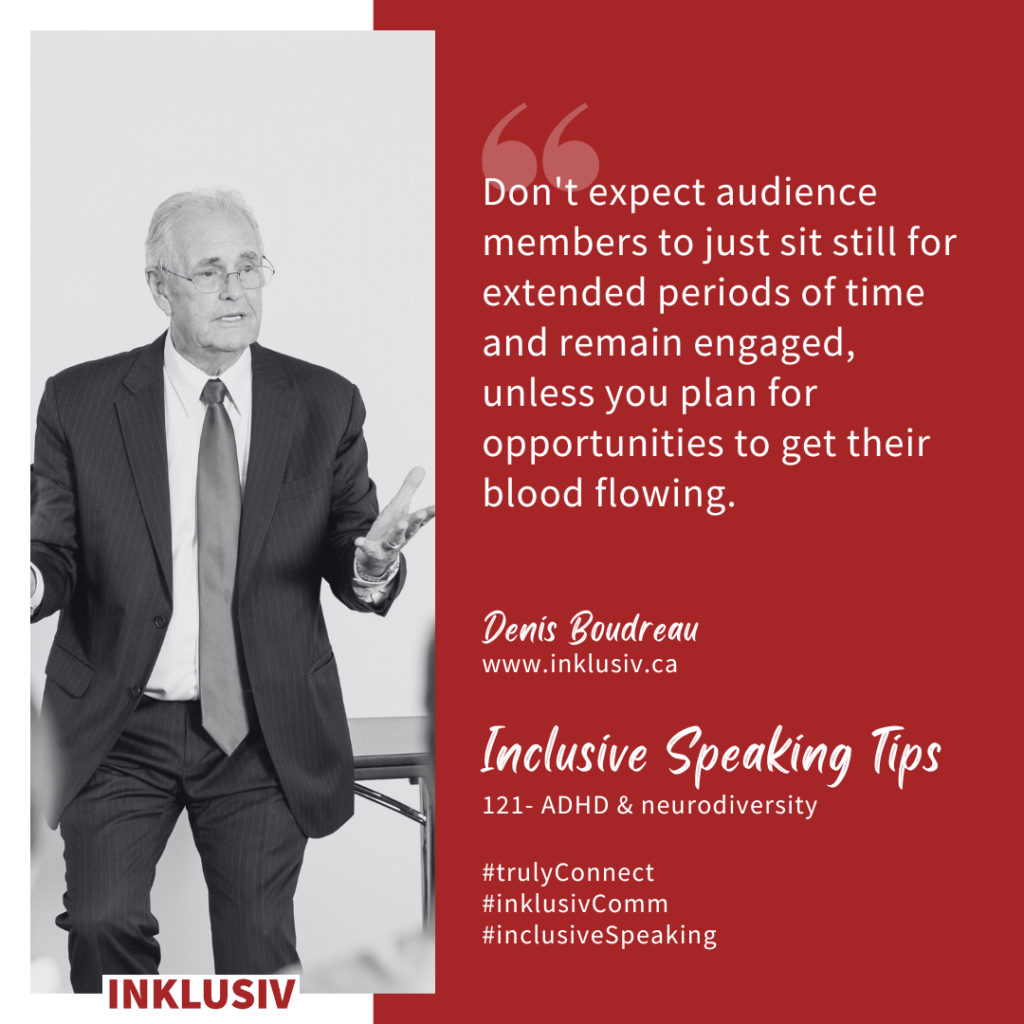
Don't expect audience members to just sit still for extended periods of time and remain engaged, unless you plan for opportunities to get their blood flowing. ADHD & neurodiversity

“Don’t expect audience members to just sit still for extended periods of time and remain engaged, unless you plan for opportunities to get their blood flowing.”

More details about Inclusive Speaking Tip #121
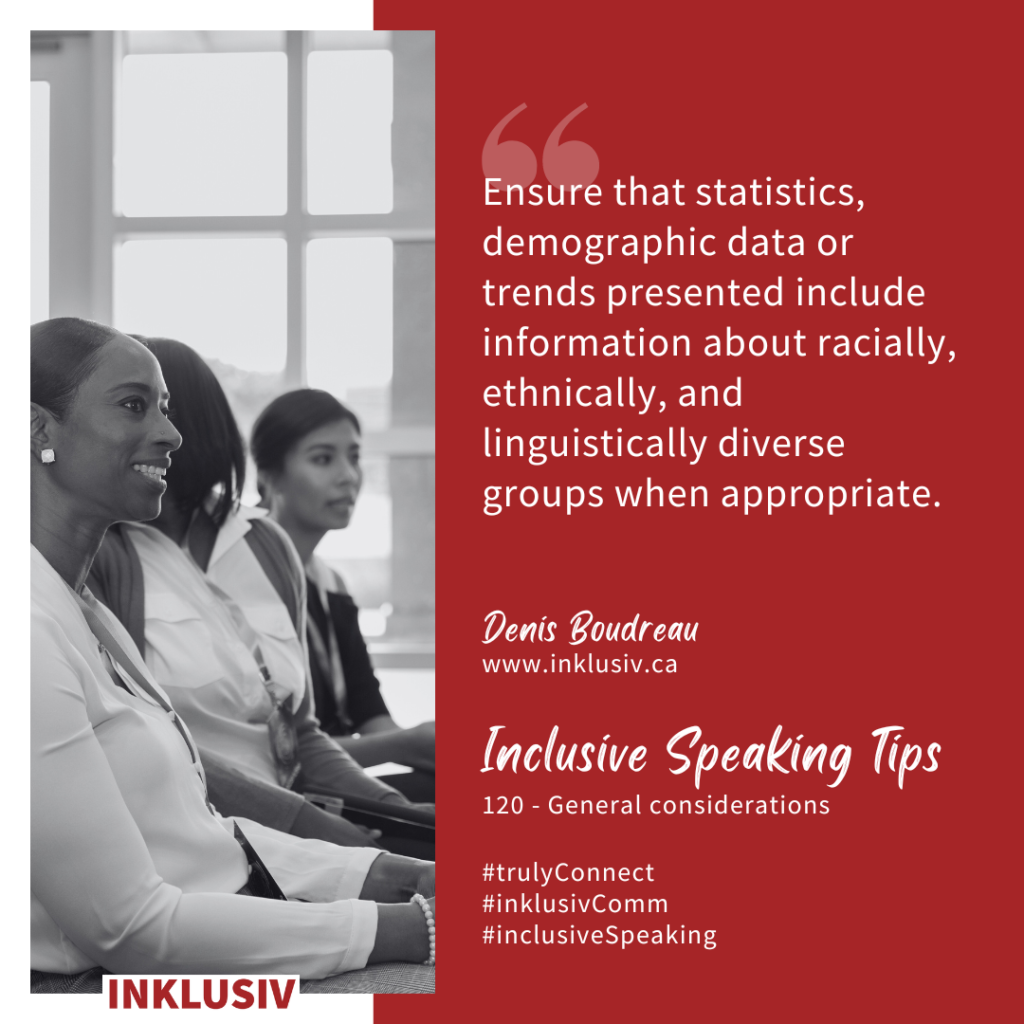
Ensure that statistics, demographic data or trends presented include information about racially, ethnically, and linguistically diverse groups when appropriate. General considerations

“Ensure that statistics, demographic data or trends presented include information about racially, ethnically, and linguistically diverse groups when appropriate.”

More details about Inclusive Speaking Tip #120
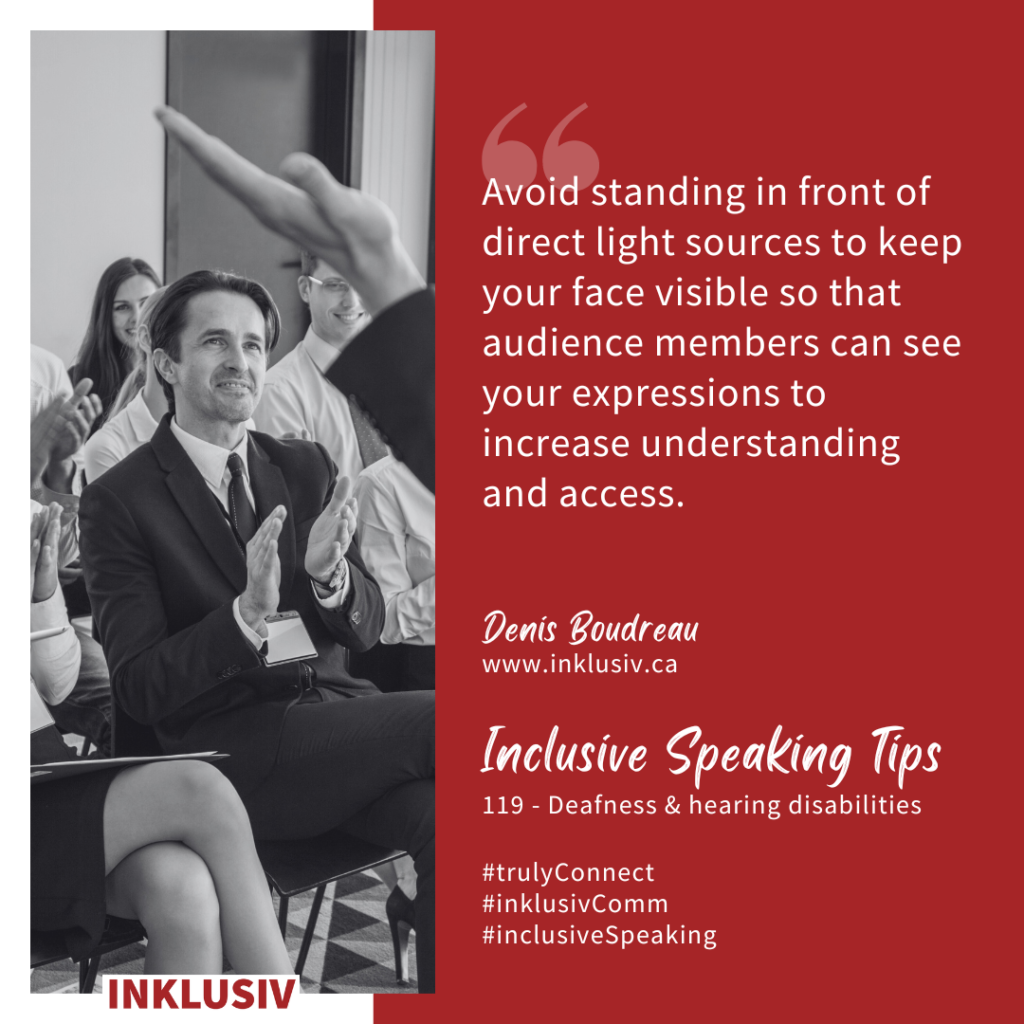
Avoid standing in front of direct light sources to keep your face visible so that audience members can see your expressions to increase understanding and access. Deafness & hearing disabilities

“Avoid standing in front of direct light sources to keep your face visible so that audience members can see your expressions to increase understanding and access.”

More details about Inclusive Speaking Tip #119
Avoid unnecessary slide transitions and animations that can trigger nausea, headaches, and dizziness for some audience members with vestibular disorders. Vestibular & seizure disorders

“Avoid unnecessary slide transitions and animations that can trigger nausea, headaches, and dizziness for some audience members with vestibular disorders.”

More details about Inclusive Speaking Tip #118
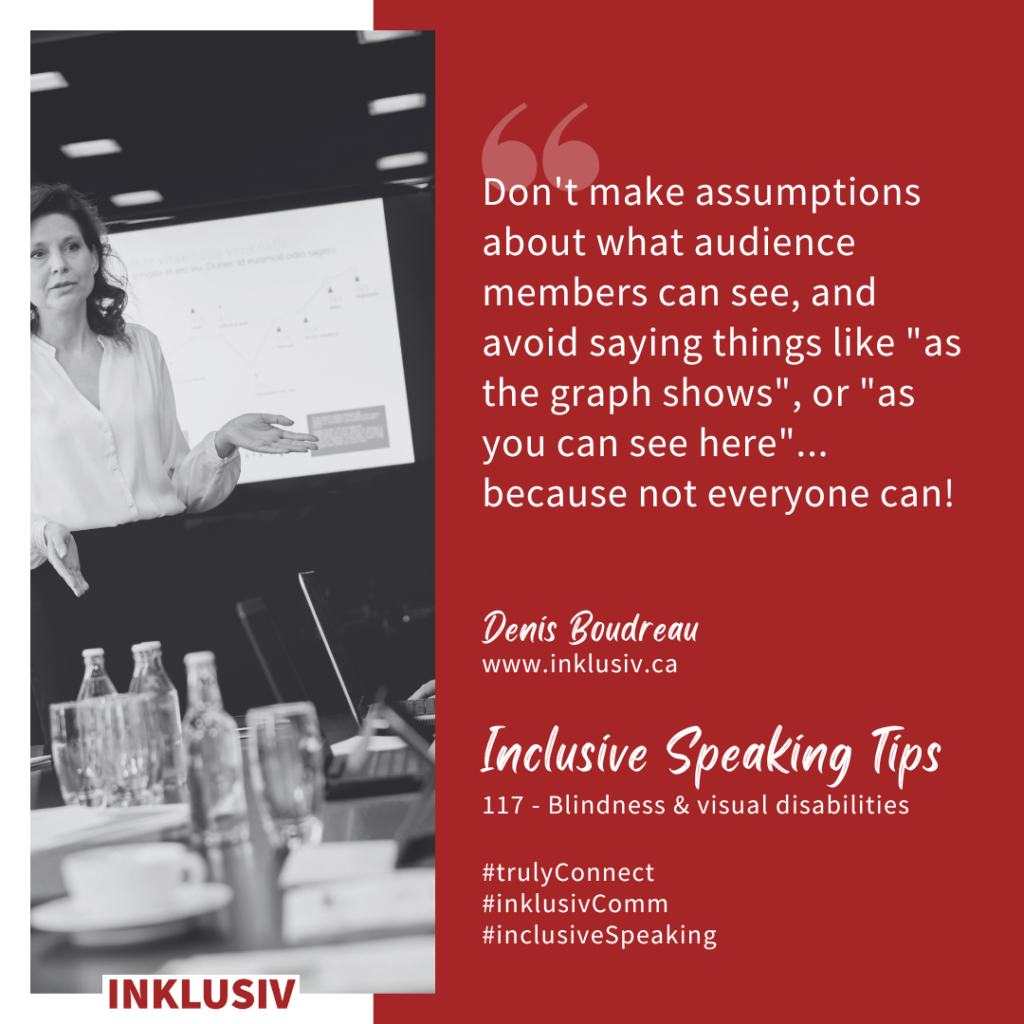
Don't make assumptions about what audience members can see, and avoid saying things like "as the graph shows", or "as you can see here"... because not everyone can! Blindness & visual disabilities

“Don’t make assumptions about what audience members can see, and avoid saying things like “as the graph shows”, or “as you can see here”… because not everyone can!”

More details about Inclusive Speaking Tip #117
Steer clear of information positioned on top of cluttered or busy background images, if that background makes the text harder to perceive due to poor contrast. Colourblindness & visual disabilities

“Steer clear of information positioned on top of cluttered or busy background images, if that background makes the text harder to perceive due to poor contrast.”

More details about Inclusive Speaking Tip #116
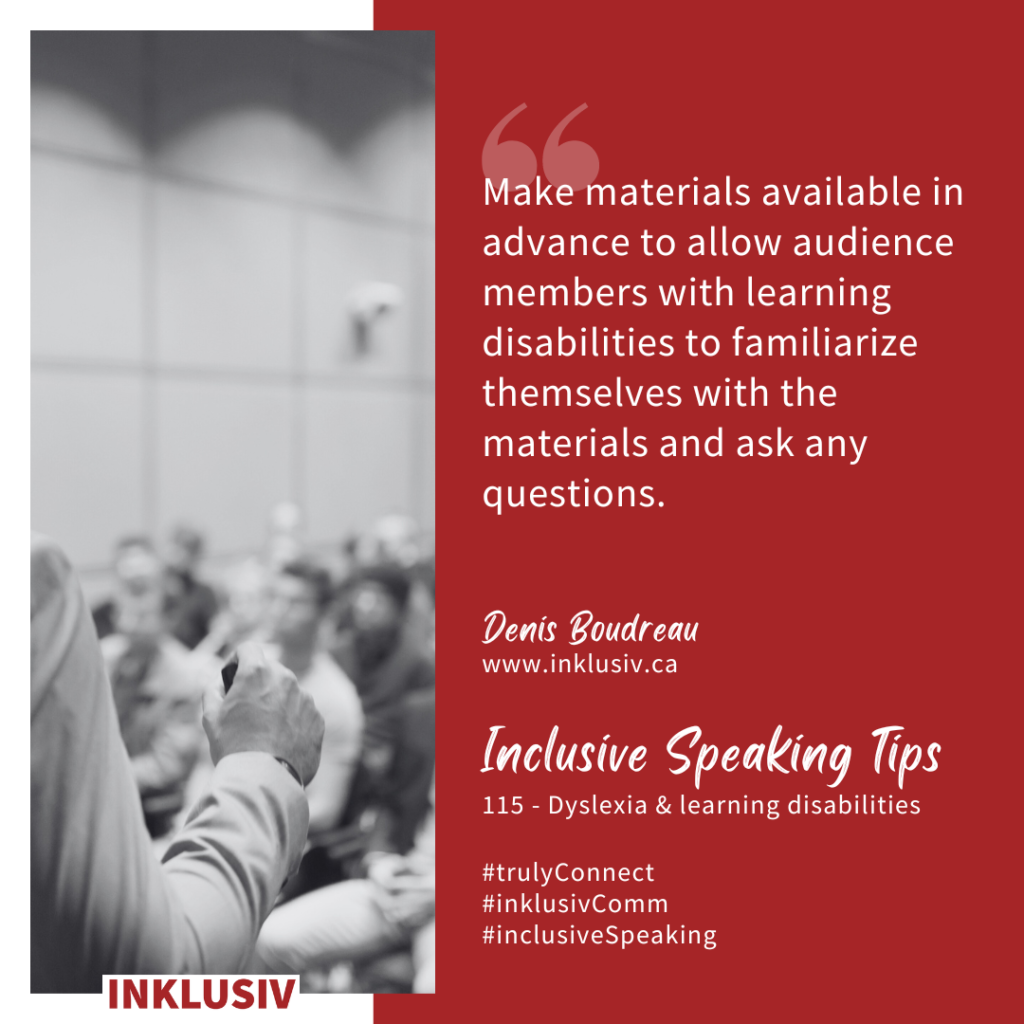
Make materials available in advance to allow audience members with learning disabilities to familiarize themselves with the materials and ask any questions. Dyslexia & learning disabilities

“Make materials available in advance to allow audience members with learning disabilities to familiarize themselves with the materials and ask any questions.”

More details about Inclusive Speaking Tip #115
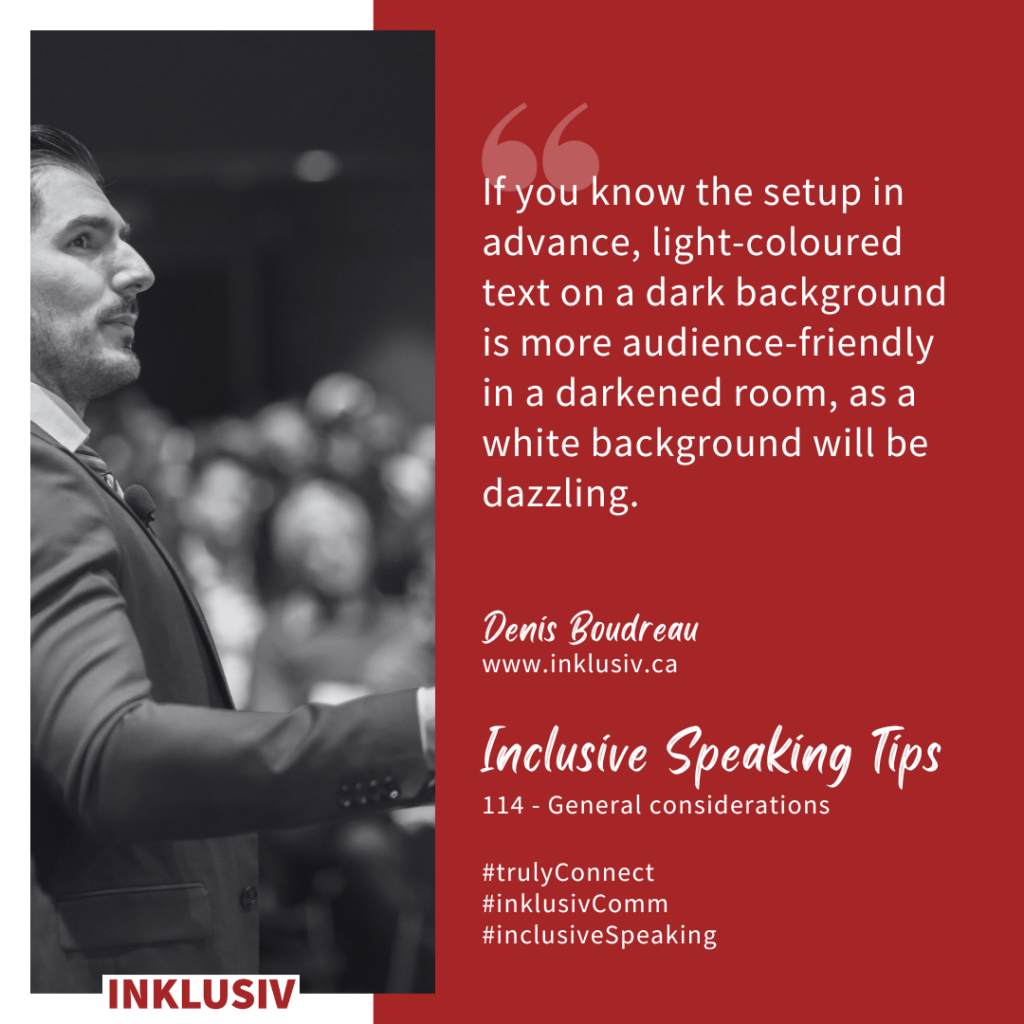
If you know the setup in advance, light-coloured text on a dark background is more audience-friendly in a darkened room, as a white background will be dazzling. General considerations

“If you know the setup in advance, light-coloured text on a dark background is more audience-friendly in a darkened room, as a white background will be dazzling.”

More details about Inclusive Speaking Tip #114
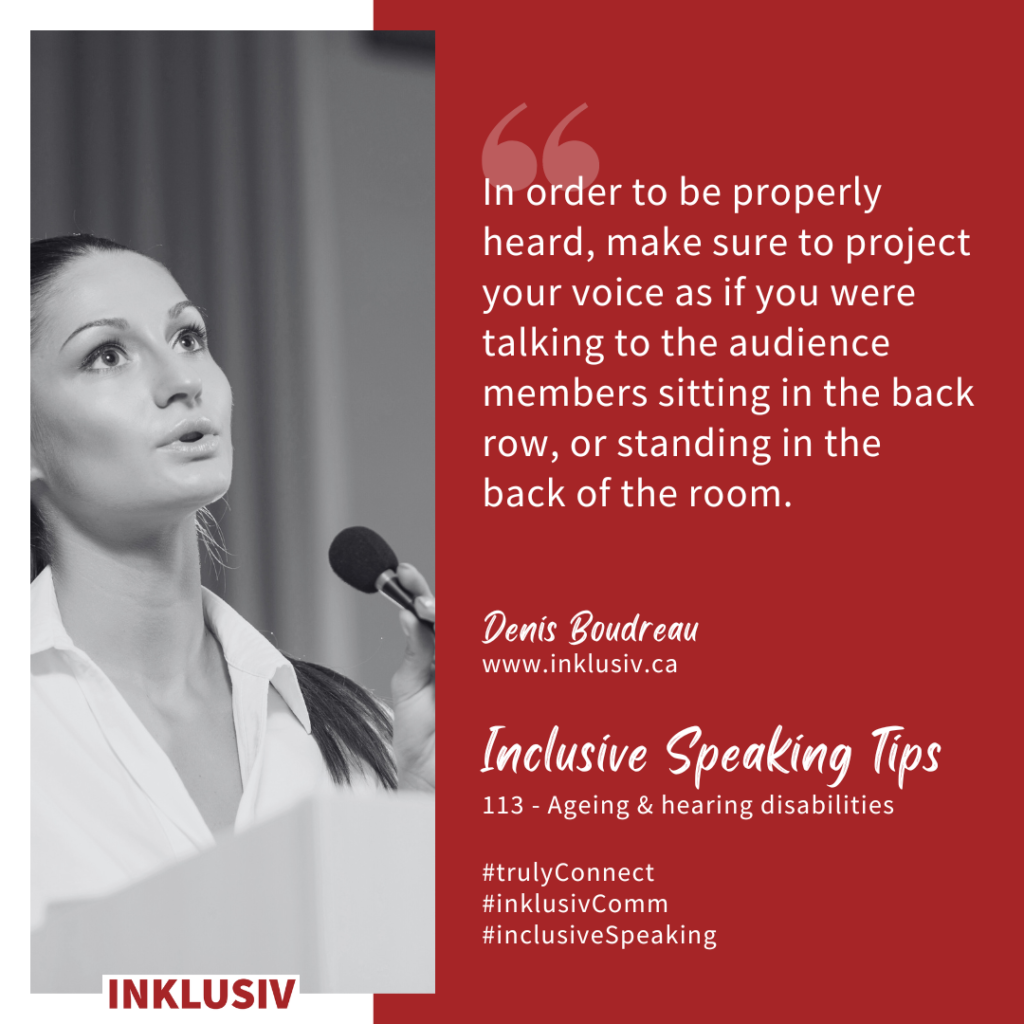
In order to be properly heard, make sure to project your voice as if you were talking to the audience members sitting in the back row, or standing in the back of the room. Ageing & hearing disabilities

“In order to be properly heard, make sure to project your voice as if you were talking to the audience members sitting in the back row, or standing in the back of the room.”

More details about Inclusive Speaking Tip #113
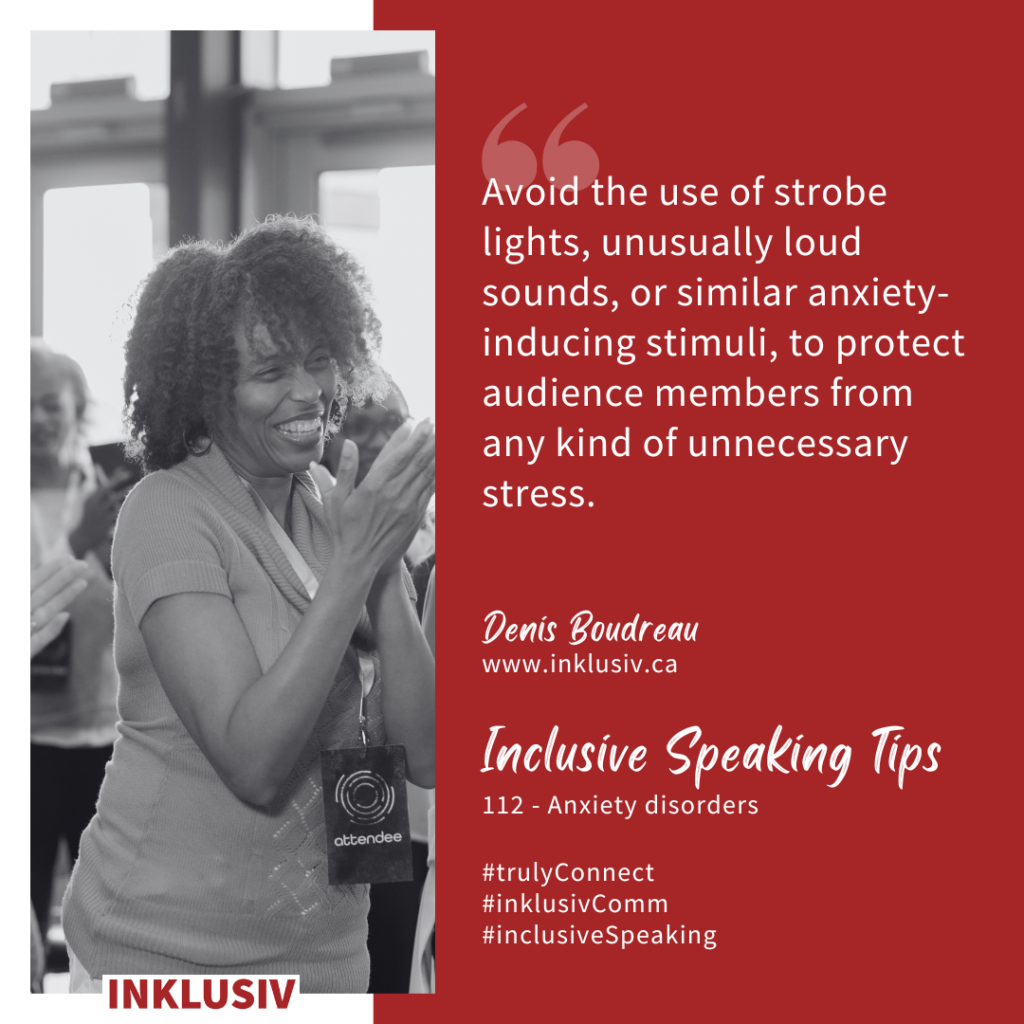
Avoid the use of strobe lights, unusually loud sounds, or similar anxiety-inducing stimuli, to protect audience members from any kind of unnecessary stress. Anxiety disorders

“Avoid the use of strobe lights, unusually loud sounds, or similar anxiety-inducing stimuli, to protect audience members from any kind of unnecessary stress.”

More details about Inclusive Speaking Tip #112
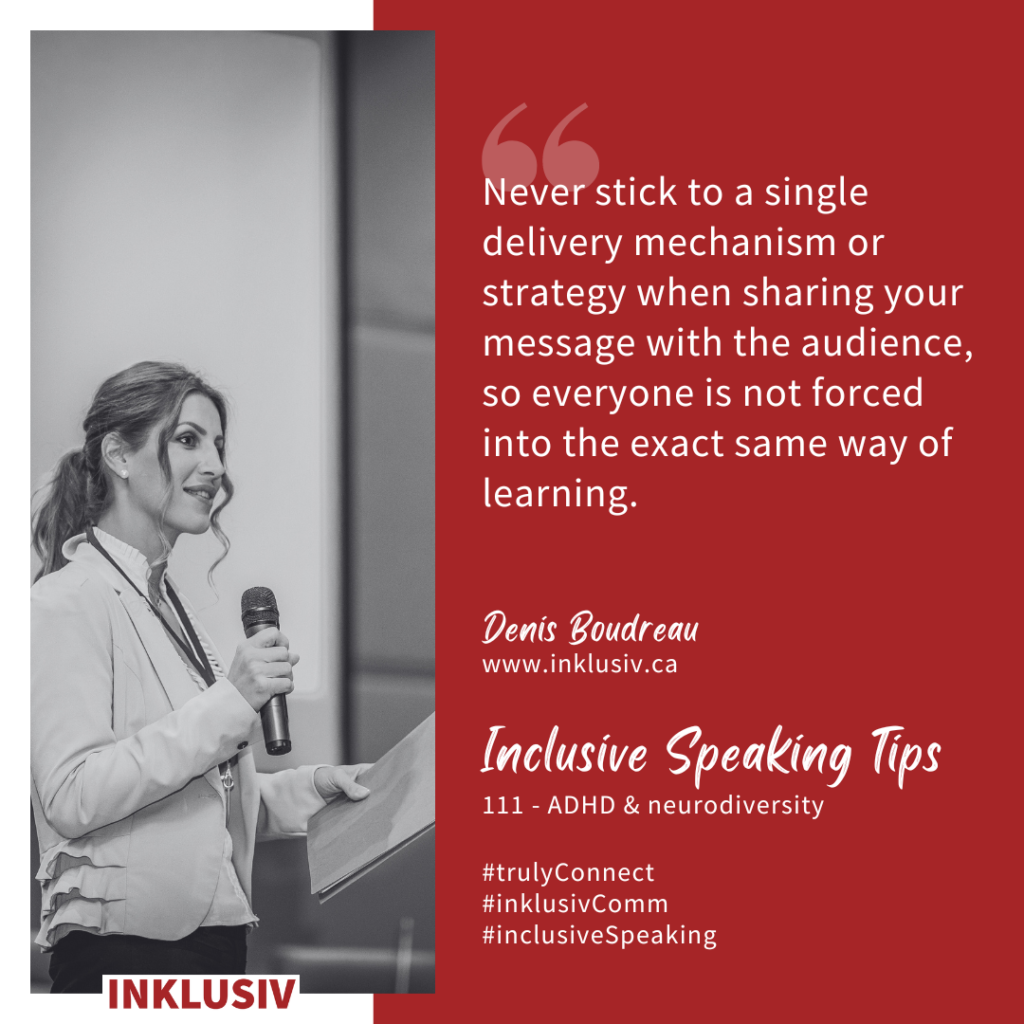
Never stick to a single delivery mechanism or strategy when sharing your message with the audience, so everyone is not forced into the exact same way of learning. ADHD & neurodiversity

“Never stick to a single delivery mechanism or strategy when sharing your message with the audience, so everyone is not forced into the exact same way of learning.”

More details about Inclusive Speaking Tip #111
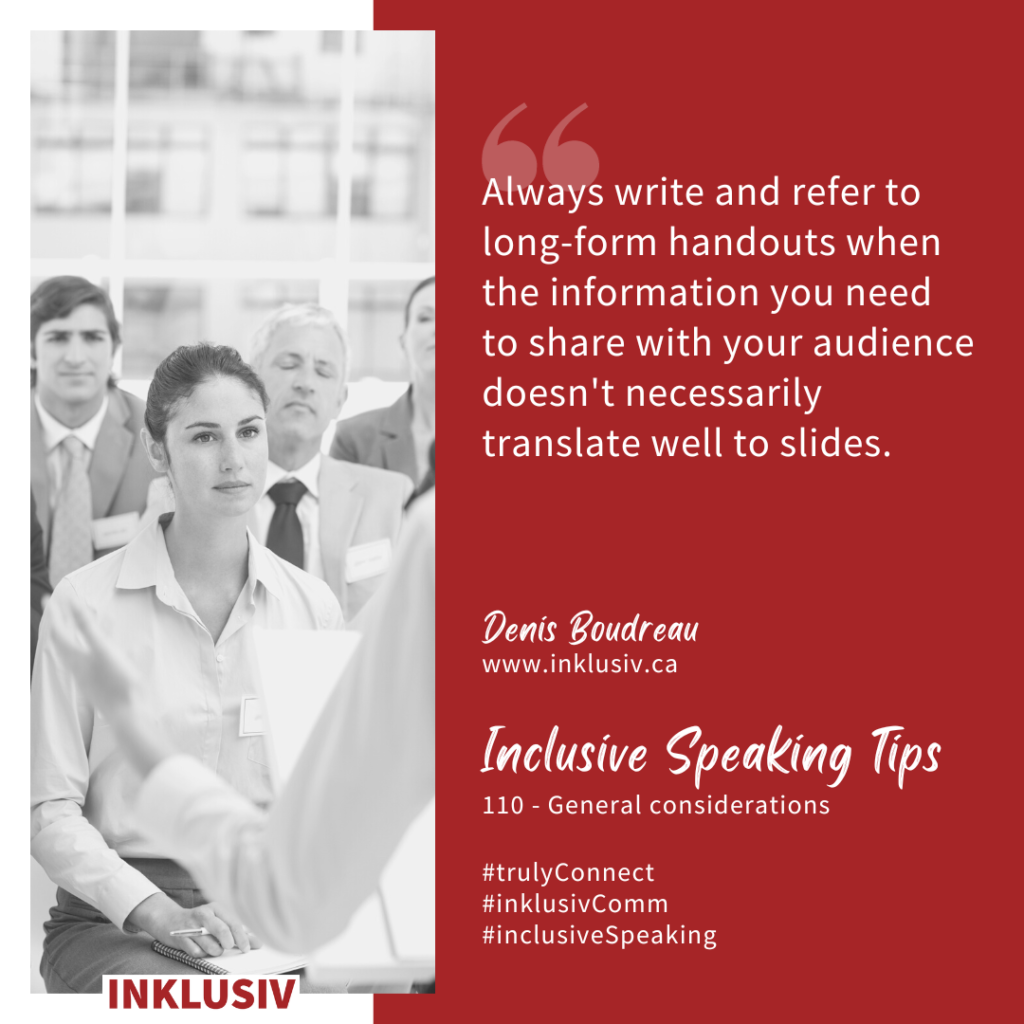
Always write and refer to long-form handouts when the information you need to share with your audience doesn't necessarily translate well to slides. General considerations

“Always write and refer to long-form handouts when the information you need to share with your audience doesn’t necessarily translate well to slides.”

More details about Inclusive Speaking Tip #110
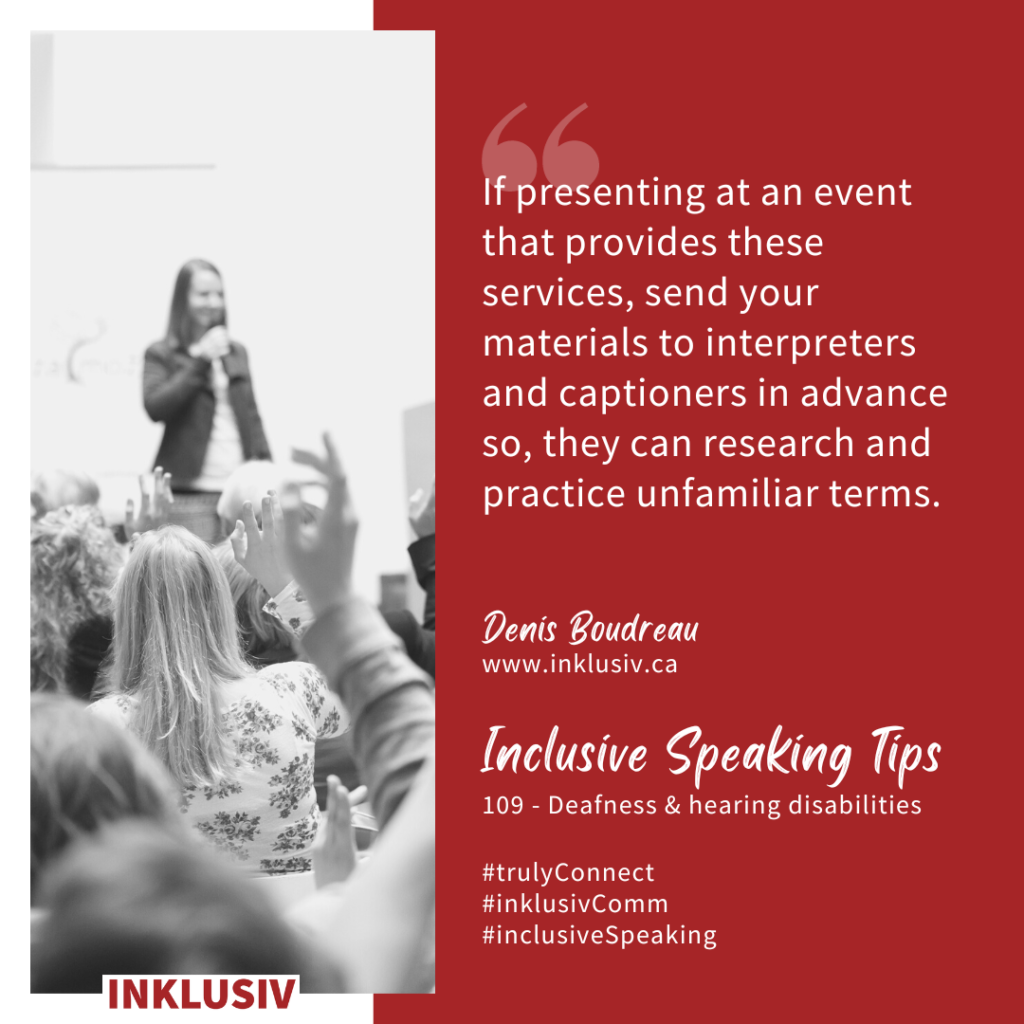
If presenting at an event that provides these services, send your materials to interpreters and captioners in advance so, they can research and practice unfamiliar terms. Deafness & hearing disabilities

“If presenting at an event that provides these services, send your materials to interpreters and captioners in advance so, they can research and practice unfamiliar terms.”

More details about Inclusive Speaking Tip #109
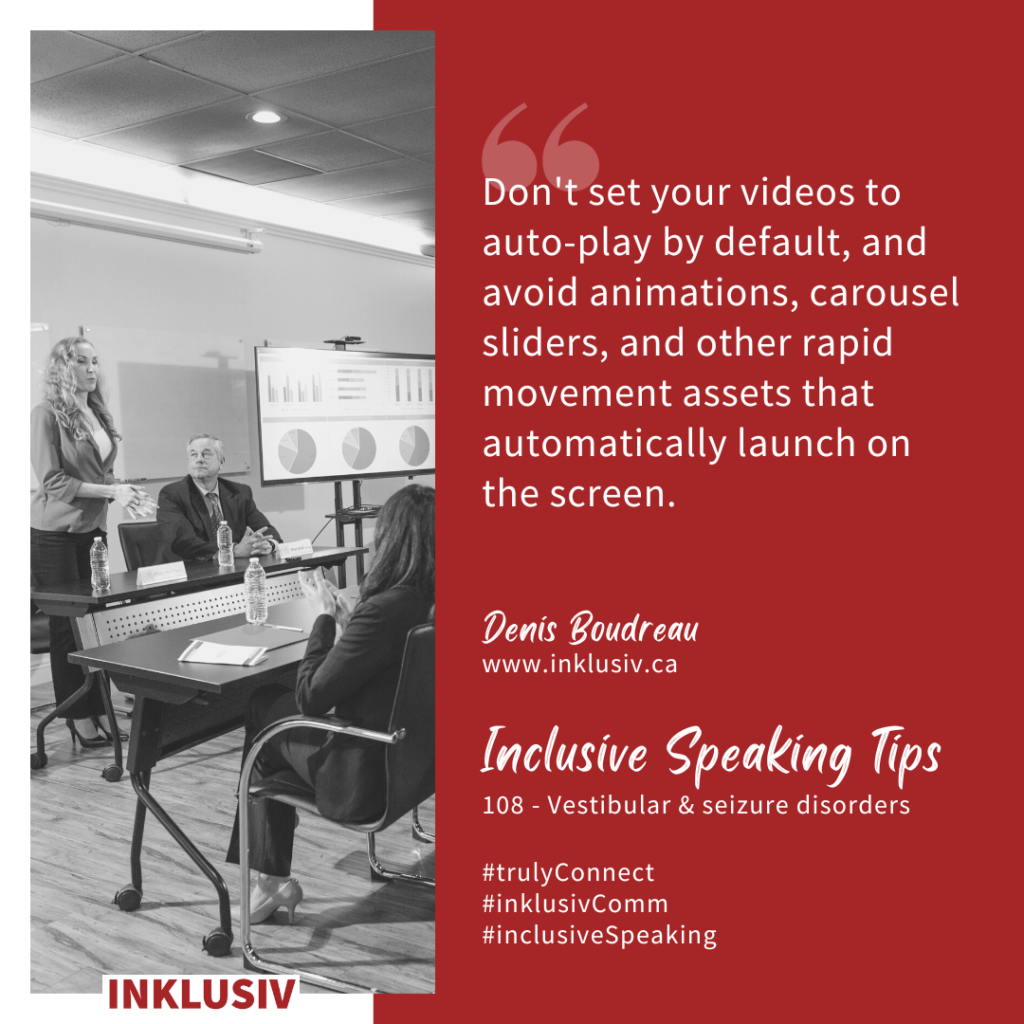
Don't set your videos to auto-play by default, and avoid animations, carousel sliders, and other rapid movement assets that automatically launch on the screen. Vestibular & seizure disorders

“Don’t set your videos to auto-play by default, and avoid animations, carousel sliders, and other rapid movement assets that automatically launch on the screen.”

More details about Inclusive Speaking Tip #108
Quickly rehash sight gags even if feels awkward, so that some of your audience members don't have to feel bad when everybody else laughs and they don't understand why. Blindness & visual disabilities

“Quickly rehash sight gags even if feels awkward, so that some of your audience members don’t have to feel bad when everybody else laughs and they don’t understand why.”

More details about Inclusive Speaking Tip #107
Always assume that your audience's ability to perceive colours will fail them when it comes to differentiating between objects that are presented in close proximity. Colourblindness & visual disabilities

“Always assume that your audience’s ability to perceive colours will fail them when it comes to differentiating between objects that are presented in close proximity.”

More details about Inclusive Speaking Tip #106
When working with text in your materials, avoid centered, right-aligned, or fully-justified blocks of text that makes processing information that much harder for some people. Dyslexia & learning disabilities

“When working with text in your materials, avoid centered, right-aligned, or fully-justified blocks of text that makes processing information that much harder for some people.”

More details about Inclusive Speaking Tip #105
Be mindful to opt for more gender-neutral alternatives such as 'folks', 'people', or 'y'all' when addressing your audience, as opposed to using the term 'guys'. General considerations

“Be mindful to opt for more gender-neutral alternatives such as ‘folks’, ‘people’, or ‘y’all’ when addressing your audience, as opposed to using the term ‘guys’.”

More details about Inclusive Speaking Tip #104
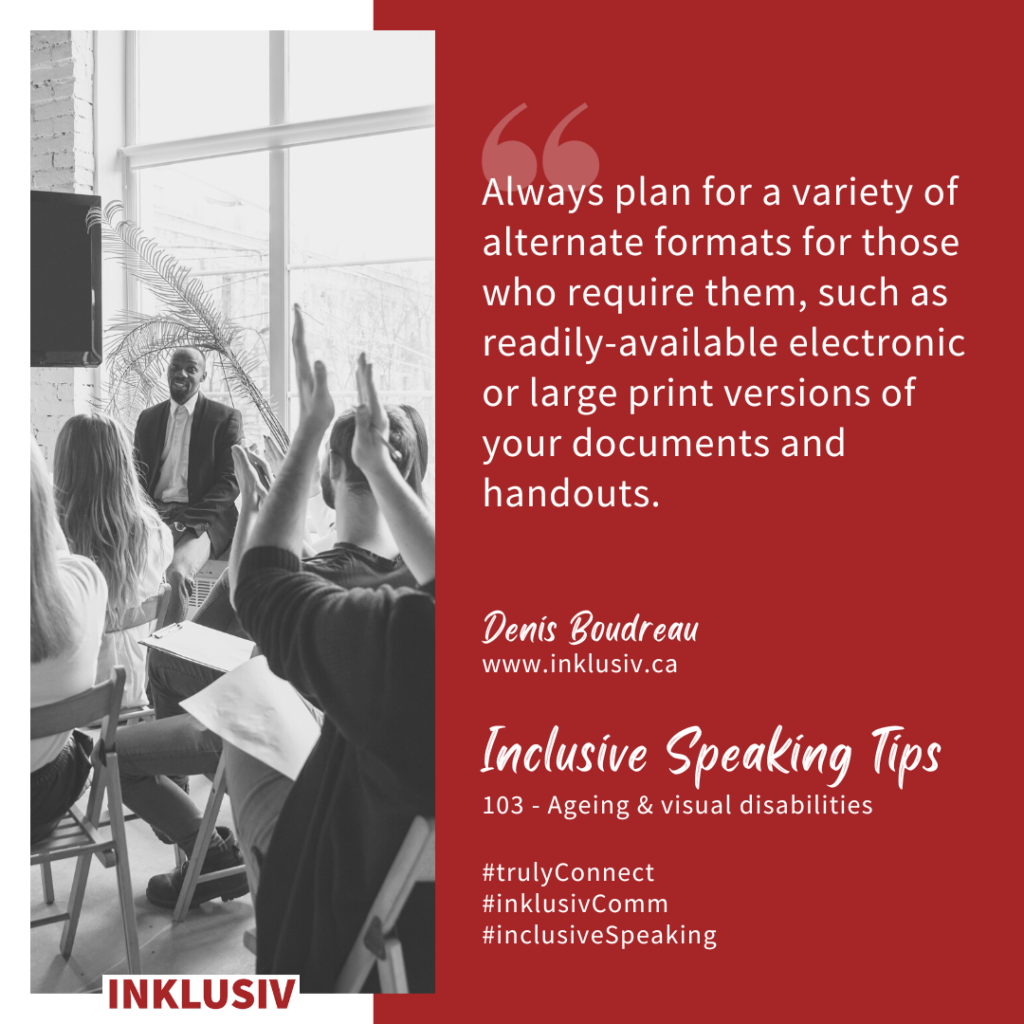
Always plan for a variety of alternate formats for those who require them, such as readily-available electronic or large print versions of your documents and handouts. Ageing & visual disabilities

“Always plan for a variety of alternate formats for those who require them, such as readily-available electronic or large print versions of your documents and handouts.”

More details about Inclusive Speaking Tip #103
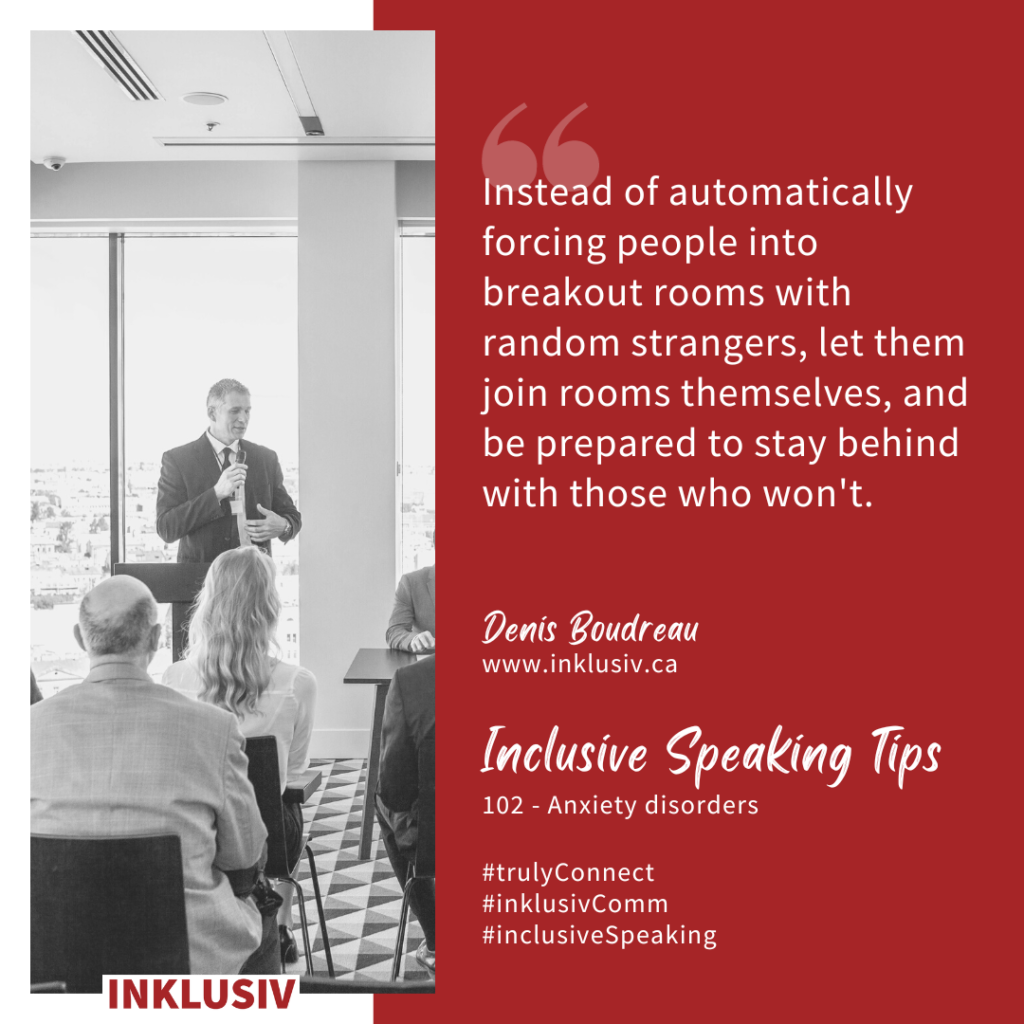
Instead of automatically forcing people into breakout rooms with random strangers, let them join rooms themselves, and be prepared to stay behind with those who won't. Anxiety disorders

“Instead of automatically forcing people into breakout rooms with random strangers, let them join rooms themselves, and be prepared to stay behind with those who won’t.”

More details about Inclusive Speaking Tip #102
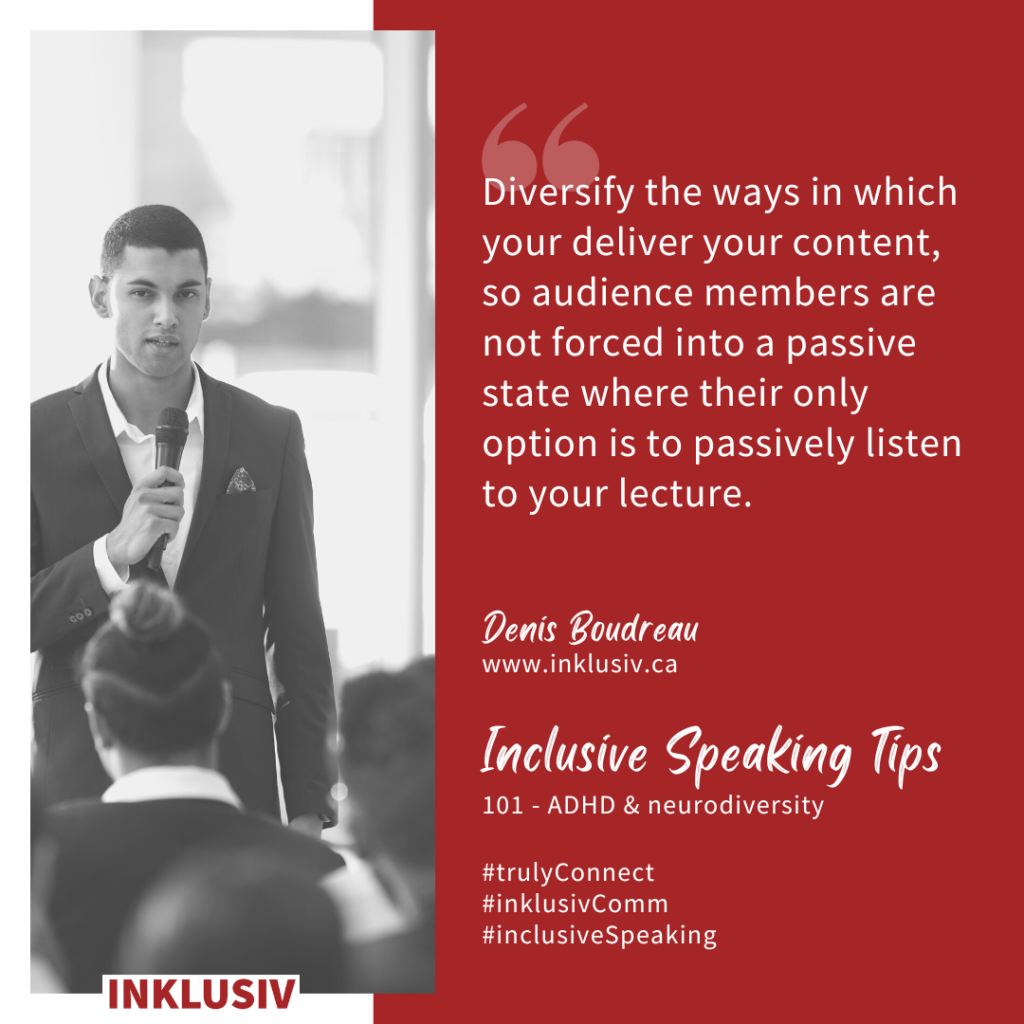
Diversify the ways in which your deliver your content, so audience members are not forced into a passive state where their only option is to passively listen to your lecture. ADHD & neurodiversity

“Diversify the ways in which your deliver your content, so audience members are not forced into a passive state where their only option is to passively listen to your lecture.”

More details about Inclusive Speaking Tip #101
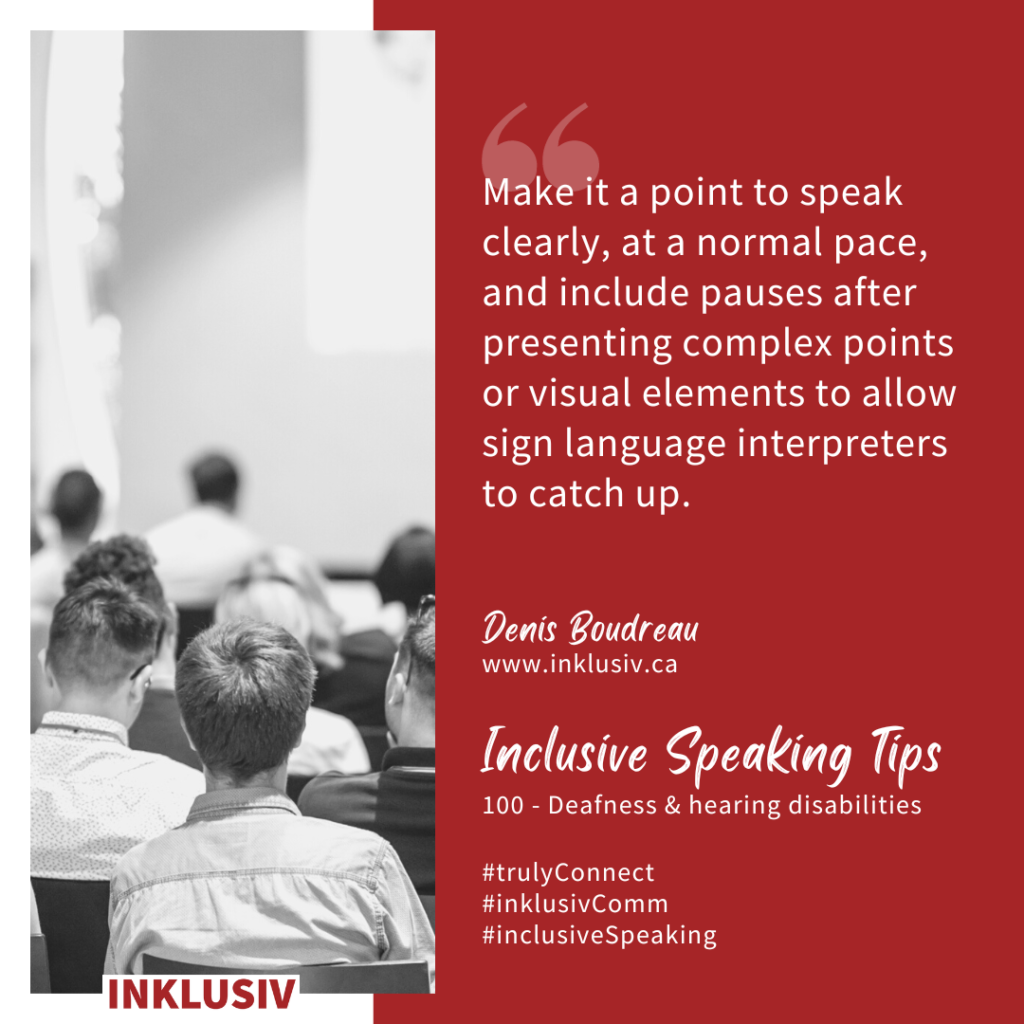
Make it a point to speak clearly, at a normal pace, and include pauses after presenting complex points or visual elements to allow sign language interpreters to catch up. Deafness & hearing disabilities

“Make it a point to speak clearly, at a normal pace, and include pauses after presenting complex points or visual elements to allow sign language interpreters to catch up.”

More details about Inclusive Speaking Tip #100
Use URL shorteners to make your links more memorable and maximize their readability by labeling them with one or two easy-to-remember words, rather than a random string of characters. General considerations

“Use URL shorteners to make your links more memorable and maximize their readability by labeling them with one or two easy-to-remember words, rather than a random string of characters.”

More details about Inclusive Speaking Tip #099
Never assume that your audience members will be able to fully rely on their hand-eye coordination to interact, pinpoint, or trigger targets on a screen. Vestibular & seizure disorders

“Never assume that your audience members will be able to fully rely on their hand-eye coordination to interact, pinpoint, or trigger targets on a screen.”

More details about Inclusive Speaking Tip #098
  • Page 1
  • Page 2
  • Page 3
  • Page 5
  • Next page

Is your digital experience  leaving people behind?

Every day, millions of people with disabilities are blocked from accessing information, services, and products – simply because organizations overlook digital accessibility. These aren’t edge cases. They’re your customers, your employees, your community.

At Inklusiv Communication, we help you change that. With over 25 years of experience, we train the teams who design, build, and maintain your digital platforms, ensuring accessibility is built in from the start.

If you’re ready to reduce risk, improve access, and serve everyone with dignity, let’s talk. Together, we’ll help you create digital experiences that don’t leave anyone behind.

“Workarounds are often mistaken for resilience. Over time, they normalize exclusion by shifting responsibility onto individuals instead of addressing the systems that created the barriers.”

~ Denis Boudreau, InklusivComm

Are you ready to truly connect?

"*" indicates required fields

Subscribe to our weekly or daily newsletter*
(You can change your preference at any time)

Drop by and come say hi!

Ideally situated right in the heart of the city, on the 19th floor of our beautiful, light-filled headquarters offer a breathtaking workspace that inspires us to create the most inclusive solutions for your business.

  • Inklusiv Communication
    235 Young street, Suite 1902
    Montreal, QC H3C 0Z6
  • +1 514-730-9168
  • [email protected]
Inklusiv Understand accessibility. Train your digital teams. Reach untapped markets.
All rights reserved © 2026 Inklusiv Communication
Branding by GoGo Telugo, Development by Ekloweb
Privacy policy | Personalize cookies
LinkedIn Youtube Instagram